Transparent privacy window film: does it really exist?
By the VitraCare Team
You want to keep seeing the street from your living room, without passers-by seeing in, and without turning your window into frosted glass. That's exactly what a transparent privacy film promises. The honest answer: yes during the day, with mirror effect film. But no film does both at every hour, and the reason lies with light itself, not with product quality. Here's what actually happens, what you give up in transparency, and which film to choose for your needs.
The short answer: yes by day, not around the clock
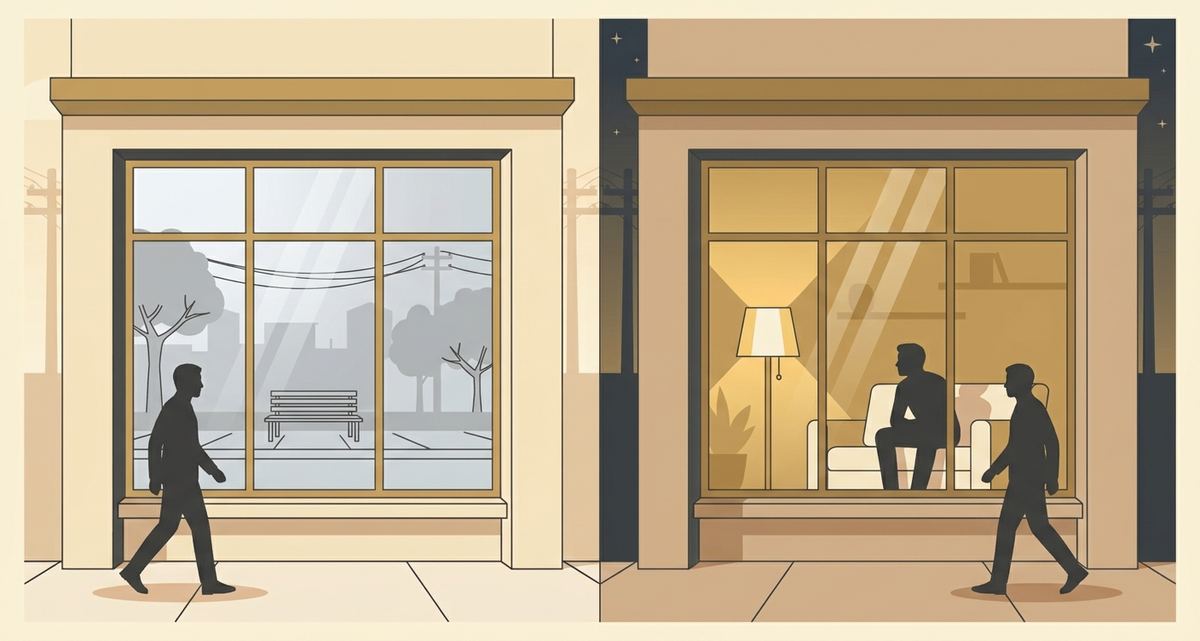
Mirror effect film, also called one-way film, is the only one that lets you see out while blocking the view from outside. It has one condition: the outside has to be brighter than the inside. During the day that's almost always the case, and passers-by see a reflection instead of your living room.
In the evening, once your lights are on and the street is dark, the balance flips. The inside becomes the bright side, and people can see in from the street. The other films don't get around this: matte white film blocks the view at all times but also blurs yours, while solar and anti-burglary films stay transparent, with no privacy at all.
Why a true 'one-way' film doesn't exist
Mirror effect film has no direction. It's a semi-reflective layer: it reflects part of the light and lets the rest through, the same way in both directions. The University of Illinois physics department's question-and-answer service, Physics Van, describes this kind of glass as partial mirrors that reflect most of the light that hits them, but not all of it.
The effect comes from the difference in light between the two sides. On the brighter side, the reflection is so strong that it drowns out the little light coming through from the other side: you see the street reflected, or yourself. On the dark side, there's almost nothing to reflect, so you see through. As the science programme The Naked Scientists explains, there's no such thing as a true one-way mirror, and if both sides are lit equally, the effect stops working.
That's why the effect fades at dawn and dusk, when the light is roughly the same inside and out. And why you should be wary of any product sold as 'transparent and one-way' at all hours: with a mirror or a standard film, it's physically impossible.
'Transparent', really? What you see from inside
From inside, the view out stays sharp. But the film isn't colourless. The one we install has a visible light transmission (VLT) of 22%: only 22% of daylight passes through the glazing, the rest is reflected or absorbed. So the room is darker than with bare glass. That's the price of the mirror effect.
Our clients with the film installed describe a slight sunglasses effect, with a very faint reflection that's also noticeable from inside. Nothing that stops you seeing out, but it's not identical to bare glass. In the evening, that inside reflection becomes clearer, for the same physical reason: the lit room has become the bright side.
In return, the same film blocks 72% of UV rays and rejects 81% of solar infrared radiation, which also helps against heat and furniture fading. Our article on UV protection explains what those figures measure, and what they don't.
Which film for which need?
The choice mostly comes down to two questions: do you need privacy in the evening, and do you want a clear view through the glass? The table sums up what each film does.
| Film | View from inside | View in by day | View in at night (lights on) | Daylight |
|---|---|---|---|---|
| Silver mirror effect | Clear, slightly darker | Blocked (reflection) | Visible (the effect reverses) | Reduced (22% gets through) |
| Black mirror effect | Clear, noticeably darker | Blocked | Much harder | Noticeably reduced |
| Matte white | Blurred | Blocked | Blocked | Gets through, diffused |
| Solar | Clear (slight blue tint) | Visible | Visible | Gets through |
| Anti-burglary | Clear | Visible | Visible | Gets through |
← Swipe to see the full table →
How to decide for your situation
If you want to see out without being seen during the day, typically a living room facing the street or overlooked by neighbours, silver mirror effect film is the right choice. If privacy also has to hold in the evening without drawing a curtain, and you accept that you'll no longer see clearly through the glass, it's matte white film, the best fit for a bathroom.
And if you want both, a clear view and privacy in the evening? No single film does it. The simplest combination remains mirror film for the day and a curtain or blind you close at night. The black tint can suit a glazed front door or a secondary window, as long as you accept a noticeably darker room at all times.
Finally, if your problem is heat, UV or security rather than prying eyes, solar and anti-burglary films keep the window transparent. Our guide to choosing your film compares the four options in detail.
How does installation work, and what does it cost?
We apply these films directly to your existing windows, generally on the interior side, in a single visit and with no removal. The installation is guaranteed for 2 years, and the film's lifespan is estimated at 10 to 15 years for an interior installation. Our article on the steps of a project walks through the process, from measurements to installation.
There's no published price list: the price depends on the surface area to be treated, and stays the same whichever film you choose. Our article on pricing explains how the estimate is calculated.
These films are a good fit if your main need is avoiding prying eyes during the day without losing your view. If you're looking for total privacy at all hours with a perfectly clear view, we'd rather tell you upfront: no film can do that, and a curtain or blind will still be needed at night.
Sources
University of Illinois, Physics Van: 'One-way Mirrors?' (2011)
The Naked Scientists: 'How does a one-way mirror work?' (2008)
Still unsure?
Contact us: we'll advise you for free based on your situation and reply within 24 hours.
Frequently Asked Questions
Does mirror effect film work on grey days?
Generally yes: during the day, even when it's overcast, the outside is usually brighter than a room. The effect mainly fades at dawn and dusk, when the light becomes similar on both sides of the glass.
Can you layer mirror film and matte white film to get both?
It's not something we do, and the result wouldn't meet the need: the matte white film would blur the view from inside anyway. To keep a view by day and privacy at night, mirror film combined with a curtain or blind remains the simplest solution.
Can you see the mirror film from the street?
Yes, during the day: it's precisely the reflection that stops people seeing in, so the window takes on a mirror-like look from outside. In the evening, with the lights on, that look disappears and people can see inside again.
Does anti-burglary film also block prying eyes?
No. It's transparent and colourless: its job is to hold the glass fragments together if the window breaks and to slow down a break-in attempt, not to block the view. Our article on security film explains how it works.
Have a window film project?
GET A QUOTE