Heat and being overlooked at the same time: mirror effect film solves both in one installation
By the VitraCare Team
A facade that heats up all afternoon, and passers-by who can see straight into the living room: in Brussels, in terraced houses exposed to both sun and street, these two problems often arrive together, not one after the other. Yet they're almost always treated separately, as if two different solutions were needed.
Two problems that often go together in Brussels
The density of Brussels housing creates this combination more often than elsewhere: a south or west-facing facade, which gets sun for a good part of the day, very often also faces a pavement, a busy street, or neighbours' windows. The natural instinct is to close the curtains for privacy, which does nothing for the heat, since the sun has already come through the glass by that point.
How one film answers both
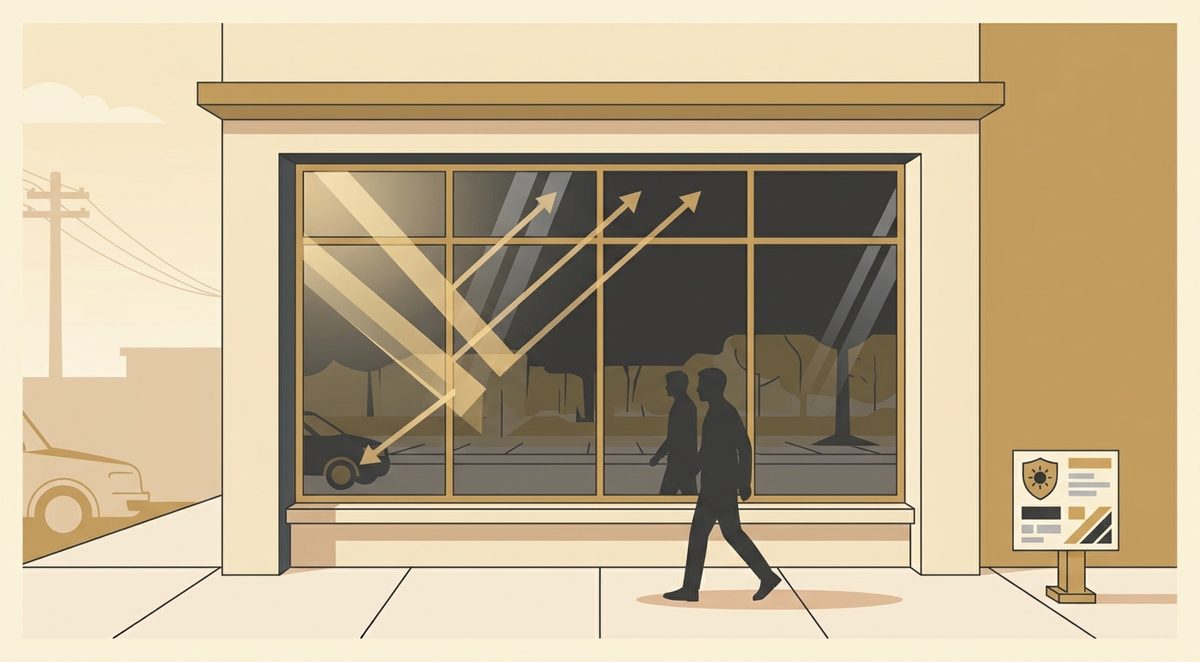
Mirror effect film relies on a simple optical principle: during the day, the outside of a room is brighter than the inside, and the film reflects that light on the outside face. That creates both the mirror effect that blocks the view from the street, and a reflection of part of the solar radiation before it turns into heat inside the room. Both effects come from the same mechanism, not two different treatments layered on top of each other.
What this actually changes about the heat
The US Department of Energy has studied the question: window films can reduce cooling-related energy consumption by up to 30%, by limiting the solar heat gain passing through the glass, which according to the same study accounts for roughly a third of a building's cooling load.
And about being overlooked
The film fully blocks the view from outside during the day, while you keep a clear, slightly darker view from inside. One thing to keep in mind: this effect only works as long as the outside stays brighter than the inside, so during the day. In the evening, once your lights are on, the effect reverses, just like with any lit window at night. If evening privacy matters to you too, our article on matte white film covers that specific need, at the cost of a more opaque result.
The other films only do one of the two
That's what makes mirror effect film unique among the 4 available tints: solar film reduces heat but adds no privacy, and matte white film blocks the view day and night but has no effect on heat. Mirror effect film is the only one of the 4 that answers both needs at once, with a single installation. Our complete guide to choosing your film compares the 4 tints with a comparison table if your situation is different.
When it really pays off
This double benefit matters most for rooms exposed to both the sun and the street: a south-facing ground-floor living room on the street, a garden-facing bay window visible from neighbours, or a west-facing facade that heats up right when the street is busiest. For a room with only one of the two problems, another film may be more suitable: our choice guide helps decide case by case.
Still unsure?
Contact us: we'll advise you for free based on your project and reply within 24 hours.
Frequently Asked Questions
Is mirror effect film more effective against heat than solar film?
Yes: both rely on the same principle of reflecting solar radiation, but mirror film, being more reflective, blocks more heat. The difference also lies in privacy and transparency: solar film stays transparent in both directions with no mirror effect at all, while mirror film blocks the view from outside during the day.
Is it more expensive to target both benefits at once?
No, our rate depends only on the surface area to be treated, not on the number of benefits you're after. It's the same film, installed once.
If I also want evening privacy, is mirror film enough?
No, the mirror effect only works during the day. For privacy at any time on top of reduced heat, you'd need to compare with matte white film, which however has no effect on heat. Our choice guide explains this trade-off.
Why not just install two different films?
That would be pointless and more expensive: mirror effect film already covers both needs with a single installation. Stacking two films on the same glazing isn't something we do, and it wouldn't add anything.
Have a window film project?
GET A QUOTE