Velux roof window too hot in summer: heat-control film, blind or shutter?
By the VitraCare Team
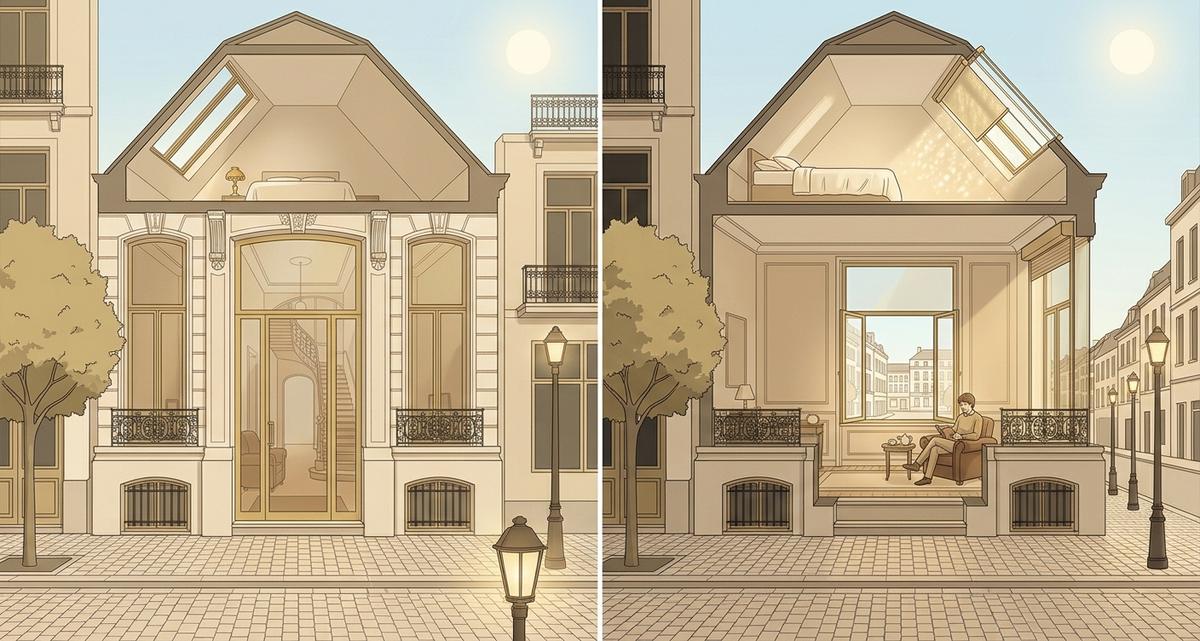
A bedroom under the roof with a Velux window (in Belgium the brand name has become the everyday word for a roof window) is bright all year. Then July comes, and it's the hottest room in the house. People sometimes ask us whether heat-control film can fix that. Our answer is straightforward: on the roof window itself, it isn't what we recommend, and we don't install film there. Here's why, and what works better.
The short answer
Against the heat of a Velux window, the most effective protection sits on the outside of the glass: an exterior awning blind or a roller shutter. An indoor blind helps, but much less. Film belongs on the upright windows of the house, alongside the blinds and shutters you close in the evening but would rather not keep closed all day.
Why a Velux window gets so hot
It isn't just a feeling. A roof window is tilted towards the sky, and the summer sun hits it far more directly than a window set in a wall. According to the Belgian consumer association Test-Achats, a roof window receives up to more than twice as much energy in summer as an upright window of the same size and orientation: on average 1,050 watts per m² of glass, against 750 for an upright window. The association compares that to a small electric heater.
And in winter it's the other way round: the roof window lets in fewer rays. So it mostly heats the room when you don't need it.
What works best: stopping the sun before the glass
Once the radiation has passed through the glass, it warms the room, even if an indoor blind stops it right behind. Test-Achats therefore recommends fitting solar protection on the outside of the roof window, and points out that indoor protection isn't effective enough against overheating.
The table below, published by Test-Achats using data from the CSTC (Belgium's building research centre), shows how much solar radiation still gets through depending on the type of protection and where it sits.
| Type of protection | Fitted outside | Fitted inside |
|---|---|---|
| Opaque | 2 to 7% | 35 to 59% |
| Semi-opaque | 16 to 20% | 39 to 59% |
| Translucent | 30 to 32% | 48 to 60% |
← Swipe to see the full table →
For a Velux window, that means an exterior awning blind, which still lets some light through, or a roller shutter, which blacks the room out completely. Roof window manufacturers sell both, sized to their models.
What about film on the Velux?
Heat-control films sold for roof windows do exist, and Test-Achats mentions solar films as an option to consider when exterior protection isn't possible. We've still chosen not to install film on roof windows.
The first reason is practical. A roof window is tilted, often high up, sometimes above a bed or a stairwell. Film is applied wet and pressed out with a squeegee inch by inch. In those conditions we can't guarantee a finish as clean as on an upright window, and we'd rather not sell a result we aren't sure of.
The second: even when well applied, film stays on the glass. It doesn't stop the sun before the pane the way an exterior blind does. Finally, a roof window has glazing designed by its manufacturer and covered by its own warranty. If you're still considering film, read your window's warranty terms first.
Where film is useful: alongside blinds and shutters
The other windows in the house often have the same problem on a smaller scale: a south-facing living room, a large sliding window, an upstairs bedroom. There are often blinds or shutters already. They're very useful in the evening, to darken the room or stop people seeing in. But during the day, it's a shame to live with the shutters closed just to keep a bit cooler.
That's where film comes in handy. Solar film stays clear and reduces the heat coming through the glass. Mirror film does the same and also blocks the view from outside during the day. Either way, light comes in and you keep your view. In the evening, you close the blind or shutter as before.
Film also filters UV: our mirror film blocks 72% of it. Our article on UV protection explains what that means for your furniture and floors. And if you're torn between film and an exterior blind on an upright window, our comparison solar film or exterior screen covers both.
Which solution for which window?
The table sums up what each solution does.
| Solution | Against heat | Daylight | For which window |
|---|---|---|---|
| Exterior awning blind | Effective | Reduced | Velux and roof windows |
| Exterior roller shutter | Very effective when closed | None when closed | Velux and upright windows |
| Indoor blind or curtain | Limited | Reduced or none | All, as a back-up |
| Solar or mirror film | Reduces heat, all the time | Comes in, view stays | Accessible upright windows |
← Swipe to see the full table →
How much does film on your other windows cost?
There's no fixed price: it depends on the surface to cover and how accessible the windows are, and it's the same whichever film you choose. The home measurement visit is free in Brussels, and our article on prices explains what makes the amount vary.
Still unsure?
Get in touch: we'll tell you for free which of your windows film makes sense on, and we reply within 24 hours.
Frequently Asked Questions
Can you put heat-control film on a Velux window?
Films for roof windows exist, but they aren't the most effective solution: exterior protection, such as an awning blind or a shutter, stops the sun before the glass. VitraCare does not install film on roof windows. If you're considering one, check your window's warranty first.
Is an indoor blind enough against Velux heat?
It helps, but not much. According to CSTC data published by Test-Achats, opaque indoor protection still lets 35 to 59% of solar radiation through, against 2 to 7% for opaque exterior protection.
Why does a Velux window get hotter than a normal window?
Because it's tilted towards the sky. According to Test-Achats, a roof window receives up to more than twice as much energy in summer as an upright window of the same size and orientation.
Can film replace shutters?
No, it complements them. The shutter darkens the room and blocks the view in the evening. Film reduces heat and glare during the day on upright windows, without closing the room off.
Have a window film project?
GET A QUOTE