
Solar window film or exterior screen: which solution against the heat?
By the VitraCare Team
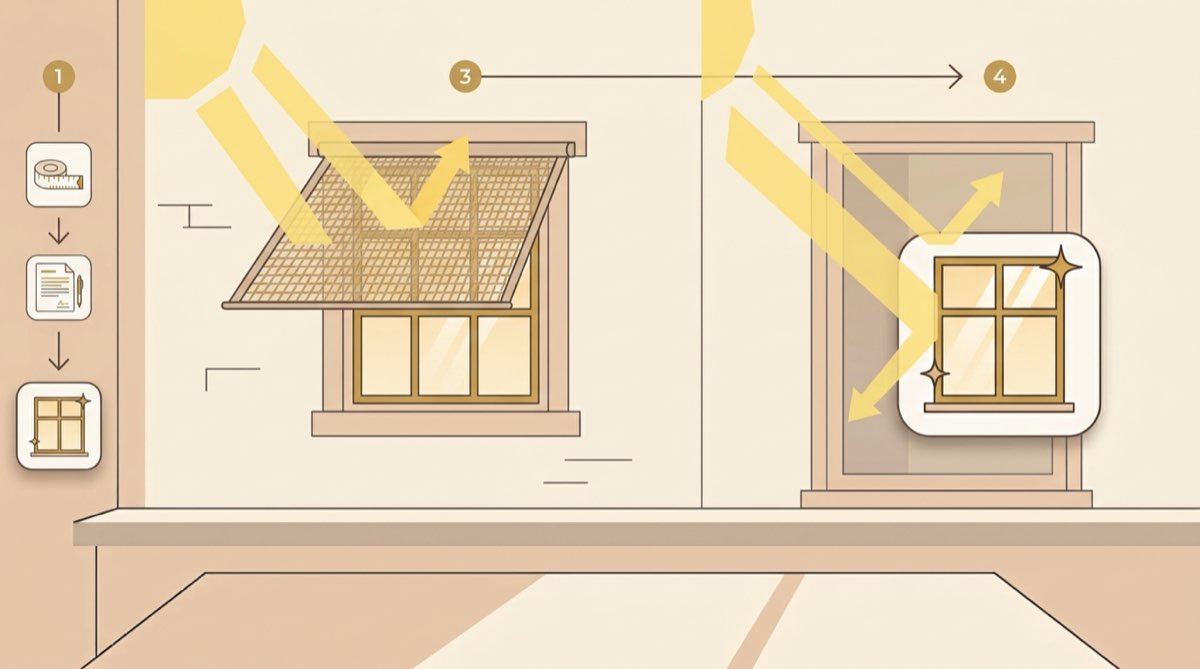
A living room that becomes unbearable by the afternoon, a south-facing bay window that turns the room into an oven: two solutions tackle this problem. The exterior screen, that awning or shade fitted in front of the window, and solar film, applied directly to the glass. They don't work the same way, and each has its own strengths. Here's what you need to know to choose.
Exterior screens: stopping the heat before it reaches the glass
An exterior screen (also called an awning, sun blind or external shutter) is fitted in front of the window, on the outside of the building. The principle: intercept the sun's rays before they reach the glass. This is the most effective method for blocking heat, since it acts upstream, before the radiation ever passes through the window. According to Consumer Reports, a well-positioned exterior awning can reduce solar heat gain by up to 65% on south-facing windows and 77% on west-facing windows.
That effectiveness comes at a cost: a screen is a mechanical fixture (motor, fabric, rails), visible from outside the building, which needs regular maintenance and can be damaged by strong wind. For a flat, installing one changes the building's façade, so it often requires approval from the co-ownership. And it only protects while deployed: left open on a heatwave day, it does nothing.
Solar film: a fixed protection, applied to the glass itself
Solar film works differently: it's applied directly to the inside face of the glazing and filters part of the radiation before it turns into heat inside the room. Since it acts on the glass itself rather than upstream, it's generally less effective than an exterior screen at blocking heat in absolute terms, but it has other, very real strengths. Our dedicated article on solar film explains how it works in detail, and our field data shows a 3 to 6°C drop in exposed rooms.
The film doesn't change the building's exterior appearance at all (no co-ownership approval needed for that), has no mechanical part to maintain, and protects continuously, with nothing to remember to operate. It's also generally cheaper to install than a motorised screen.
Can the two be combined?
Yes, and it's actually a good option for the most exposed rooms (conservatories, south-facing bay windows): the screen handles summer heat peaks when deployed, and the film provides continuous baseline protection, summer and winter, regardless of whether anyone remembers to close the screen.
Which solution should you choose?
If you're after the most effective solution possible for an extremely exposed room, and budget, maintenance and co-ownership approval aren't an issue, an exterior screen remains the benchmark. If you want a simple, maintenance-free protection that doesn't change your façade's appearance, with a more contained budget, solar film is the more practical choice. Our article on pricing explains what affects the cost of an installation.
Still unsure?
Contact us: we'll advise you for free based on your project and reply within 24 hours.
Frequently Asked Questions
Is an exterior screen always more effective than solar film?
For blocking the maximum amount of heat in absolute terms, yes, since it acts before the radiation reaches the glass. But solar film remains very effective day to day, with the advantage of always being active, with nothing to operate.
Can solar film replace an exterior screen?
For an extremely exposed room (a south-facing conservatory, a large bay window), a screen remains the most radical solution. For most rooms, solar film is more than enough and avoids installing a mechanical fixture.
Do I need approval to install an exterior screen on a flat?
Generally yes, since it changes the building's exterior appearance. Solar film, applied on the inside of the glazing, doesn't change the building's appearance at all and avoids that step.
Does solar film need any special maintenance?
No, cleaning with water and mild soap is enough. Unlike a screen, it has no mechanical part, motor or fabric to maintain.
Can I install solar film if I already have an exterior screen?
Yes, the two work very well together. The film stays active continuously, even when the screen is retracted, and also protects against UV, which the screen no longer does once folded away.
Have a window film project?
GET A QUOTE