Cheap window film (Action, Brico, Hubo...) or professional installation: how to choose?
By the VitraCare Team
A roll of window film from a hardware or home store costs roughly ten to thirty euros, against a custom quote for a professional installation. The price difference is real, but it doesn't tell the whole story: these two solutions don't always answer the same need. Here's what actually differs, so you can choose based on more than just the price tag.
What is a cheap window film, exactly?
The films sold in hardware or home decor stores (Action, Brico, Hubo, Zelfbouwmarkt, and similar chains) are almost always static cling films: they hold onto the glass through an electrostatic effect, with no glue. That's what lets you apply them yourself in a few minutes, and remove them just as easily. They're sold in small rolls, typically around 45 to 70 cm wide by 1.5 metres long, at prices from roughly ten to thirty euros depending on the store and size. At Brico, for instance, a static film at 45 × 150 cm costs €11.99. Some of these films print a UV protection percentage on the packaging (up to 95% claimed by the manufacturer for this model), but that's a manufacturer's claim, not independently measured data like what we provide on a datasheet.
The real limits of these films
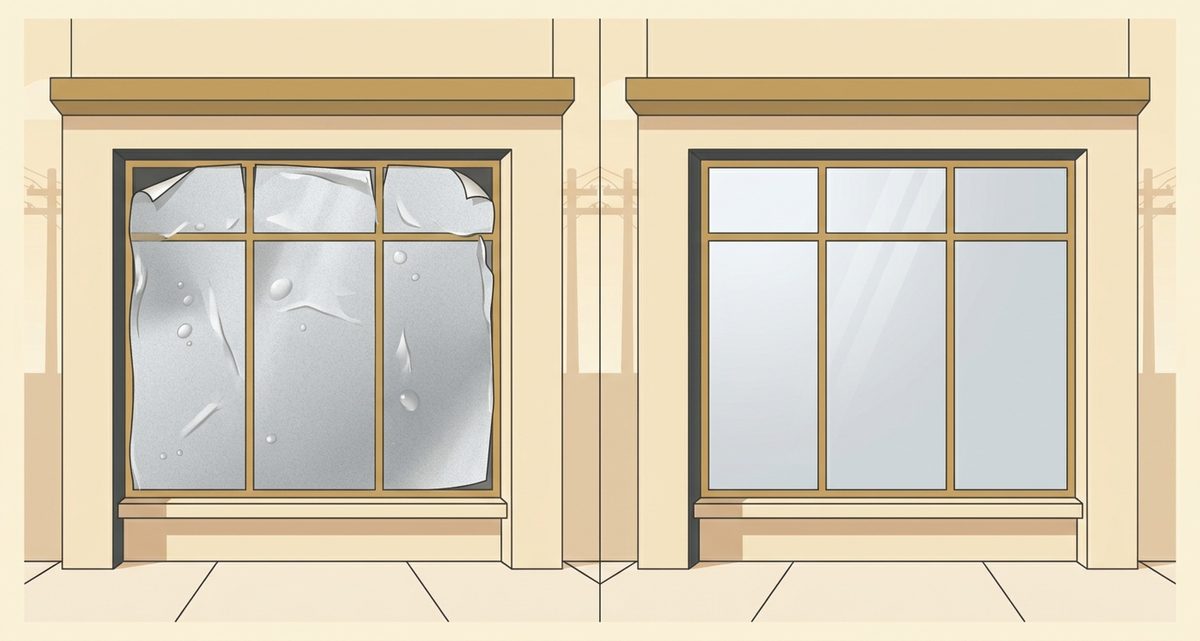
Static cling has a downside: it holds up less well over time than a glued film, especially in a humid room (bathroom) or one with temperature swings. On the Bricozone forum, one user describes a film bought at Brico that peeled off on a south-facing window after a few weeks, while it held up fine on a north-facing one, a report that can't be generalised to every case, but which illustrates the method's limits under sun exposure and temperature swings well.
Second limit: these films are almost always decorative or frosted, designed for visual privacy, not for independently measured thermal or UV performance. Some print a UV protection percentage on the packaging, but that's a manufacturer's claim. Unlike the film we install, whose technical characteristics (light transmission, UV rejection, infrared rejection) are given on a supplier datasheet, a cheap film generally comes with no independently measured data at all.
Third, more practical limit: the roll widths (45 to 70 cm) force seams on any window wider than a single roll, with a risk of air bubbles, creases, or a slight shade mismatch between strips, especially on a first attempt.
When a cheap film is more than enough
Let's be honest: for a one-off need or a small area, a cheap film can be more than enough. A small toilet or basement window, a temporary privacy need while moving, a tight budget for a single pane: in these cases, investing in a professional installation doesn't necessarily make sense.
When professional installation really makes a difference
For a larger window, a long-term need, or a specific function (genuinely reducing heat, protecting against UV, reinforcing break-in resistance), the differences carry more weight. Professional installation uses a glued film, not a static one, applied in a single continuous layer across the full height of the glass, with no visible seam. We give you measured characteristics rather than a vague promise, the installation is covered by a two-year warranty, and if an installation defect or a poorly applied tint shows up (which generally becomes visible within the month), we come back to fix it.
In practice, we're rarely called back to redo a badly installed film: the requests we get afterwards are usually about other windows to equip, or about cleaning (the film can't tolerate standard chemical products, a maintenance service we also offer).
Quick comparison table
To sum up the differences between both options at a glance.
| Cheap film (store-bought) | Professional installation by VitraCare | |
|---|---|---|
| Fixation | Static cling, no glue | Continuously glued film |
| Finish on large windows | Visible seams beyond one roll | Continuous installation, no seam |
| Measured performance (VLT/UV/infrared) | Not provided | Given on datasheet |
| Warranty | None | 2 years on installation |
| Estimated lifespan | Variable, depends on application and environment | 10 to 15 years |
| Price | ~€10 to 30 per roll | Custom quote based on surface area |
← Swipe to see the full table →
Sources
Zelfbouwmarkt — static frosted window film
Hubo — Lineafix static window film 46 × 150 cm (page in Dutch)
Still unsure?
Contact us: we'll advise you for free based on your project and reply within 24 hours.
Frequently Asked Questions
Does a cheap film damage the window?
No, neither a static nor a glued film damages the glass itself. The difference lies in durability and finish, not in any risk to the window.
Can a cheap film be replaced by a professional installation later?
Yes, a static film comes off easily since it isn't glued. The window is then ready for a professional installation if your needs change.
Does a cheap film reduce heat or UV the way a professional film does?
Not in the same way: these films are almost always purely decorative, with no measured performance data. Our mirror-effect film, for instance, has a UV rejection of 72% and an infrared rejection of 81%, figures that are generally not provided for a cheap film.
Why are cheap films mostly applied to small surfaces?
They're sold in rolls roughly 45 to 70 cm wide: beyond that, you need several strips with a risk of a visible seam, which quickly becomes tricky on a large window.
Does VitraCare display its prices?
No, the rate depends on the surface area, not on the film chosen: we always draw up a personalised, free quote rather than displaying a fixed price.
Have a window film project?
GET A QUOTE