Tinted windows for your home: tinted film, mirror film or tinted glass?
By the VitraCare Team
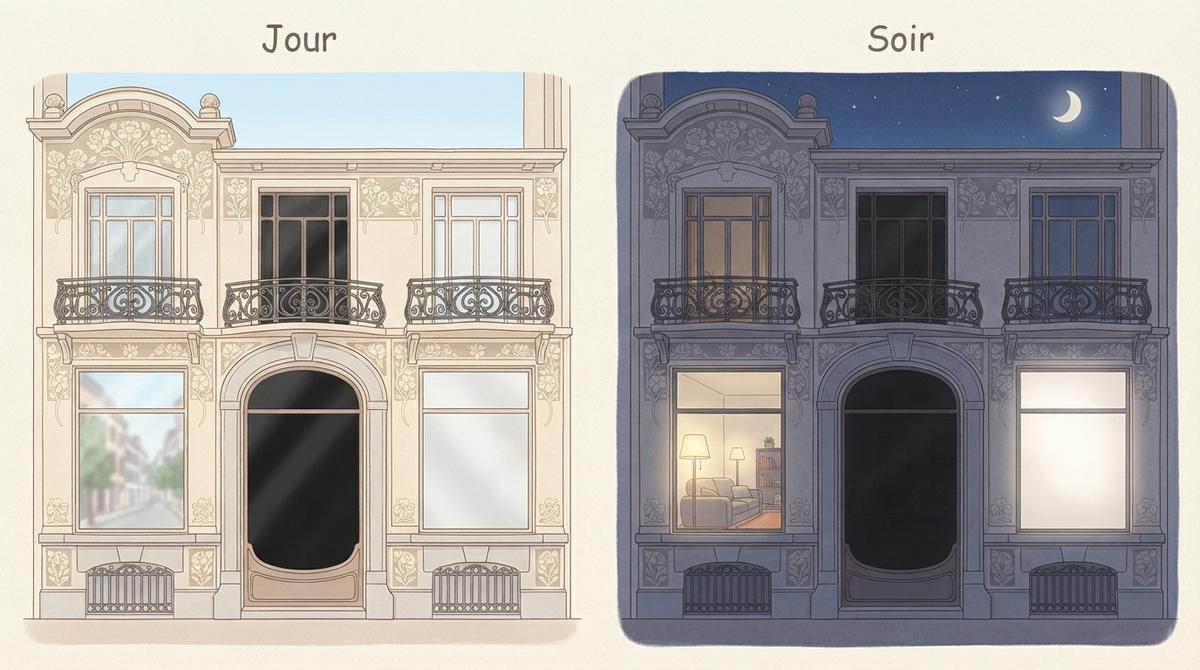
"Tinted windows, like on a car": that is the picture many people have in mind when they want fewer eyes on them or less sun in the house. In a home, it almost always means a film applied to the existing glass. But the result depends a lot on the film: what people see from the street, how much light stays in the room, the heat, and above all what happens in the evening.
The short answer
There are two ways to tint the windows of a house: apply a film to the existing glazing, or replace the glazing with tinted or solar control glass. When the windows are in good condition, film is the simplest option.
A tinted window darkens the room, cuts glare and hides the interior by day. In the evening, with the lights on, the effect reverses: people can see in again. Only a very dark tint still clearly limits the view, at the cost of a room that stays dark all day. And a darker window does not necessarily keep the house cooler.
One thing before going further: we fit film on the windows of houses, flats and offices in and around Brussels. We do not tint car windows.
Tinted film, mirror film, tinted glass: three different things
The word "tinted" covers three products that work differently. In its report on solar control films (in French), the Belgian consumer association Test-Achats puts it this way: tinted film has a colour layer that absorbs part of the light and heat, while mirror film has a thin metallised layer that reflects part of the solar radiation. Tinted glass is tinted or treated when the glass is made.
| Tinted film | Mirror film | Tinted glass | |
|---|---|---|---|
| How it works | A colour (grey, bronze or blue) absorbs part of the light and heat | A thin metallised layer reflects part of the sun | The glass is tinted or treated at the factory |
| From the street, by day | Darker window | Window that reflects like a mirror | Depends on the glass chosen |
| From the street, in the evening (lights on) | You can see in | You can see in; the black version clearly limits the view | You can see in |
| Work involved | Fitted on the existing glass | Fitted on the existing glass | Glazing replaced |
← Swipe to see the full table →
At VitraCare we fit mirror effect film in a silver or black version, a solar film that stays transparent with a slight blue tint, a matte white film and a security film. For a "tinted window" look, mirror film comes closest, especially the black version. Our guide to choosing a film compares all four.
By day: what people see from the street, and what you see from inside
By day, it is not the colour alone that hides the interior, it is the difference in light. Outside is far brighter than the room. From the street, the window mostly reflects the sky and the facades opposite, and the little light coming out of your room gets lost in that reflection. Mirror film strengthens the reflection, tinted film darkens the interior further: either way, it is hard to make out what is going on inside.
From inside, you see out normally, just a little darker, as with sunglasses. The figure that tells you how much a tint will darken the room is visible light transmission (VLT): the share of visible light that passes through the window. The lower it is, the darker the room. Our silver mirror film lets through 22% of visible light; the black version, much less.
Always ask for that figure before choosing a tint, and think about the room: a living room where you spend your days copes less well with a dark tint than a hallway or a stairwell.
In the evening, tint is no longer enough
In the evening, everything flips. It is dark outside and the lights are on inside: now the interior is the lit side. The mirror film becomes a mirror for you, on the inside, and people can see in from the street. This is not a flaw in the film, it is physics, and it is just the same with factory-tinted glass. We explain it in detail in our article on transparent privacy window film.
The black version of our mirror film clearly limits the view even in the evening, because it lets through much less light. The trade-off is a room that stays dark all the time. It suits a secondary window or a hallway, much less a living room. For a glazed front door, we would rather recommend matte white, as we explain in our article on glazed front doors.
Someone setting up a home gym recently asked us exactly this: privacy by day, keeping the light, and not being seen in the evening with the lights on. We recommended matte white film rather than mirror film: it blocks the view both ways, day and night, and lets the light through. The only drawback is that you no longer see clearly through it. If you want to keep the view by day, the simplest solution is still mirror film, with a curtain you close in the evening.
Darker does not mean cooler
You might think a darker window keeps the house cooler. It is not that simple. According to Test-Achats, tinted films have a "moderate" effect against overheating, because they mostly absorb heat rather than reflect it. That absorbed heat warms the glass, and part of it still ends up in the room.
Mirror films reflect part of the infrared back outside. And there are clear films, which Test-Achats calls spectrally selective or ceramic, that limit overheating while keeping the windows almost transparent. If heat is your only problem, there is no need to darken the room: our solar film stays transparent.
To see what you can really expect from a film against heat, and how to read a data sheet, read our article heat-control window film: does it really work?
Dark film on double glazing: something to check
A film that absorbs a lot of heat also warms the pane it is stuck to. On double glazing, this creates stress in the glass and, under the wrong conditions, thermal breakage. Test-Achats goes as far as advising against interior films for this reason.
Film manufacturers, for their part, publish compatibility tables: the risk depends on the film, the type of glass, the size of the pane and its exposure. That is why we look at your glazing during the visit, and suggest exterior fitting when it is the safer option. To date, we have never had a pane crack after fitting. It is all covered in our article on film on double glazing.
The facade: do you need permission?
A mirrored or very dark window stands out from the street. Test-Achats points this out too: the shiny look of mirror films can change how the windows look.
In Brussels, the regional planning leaflet on windows and frames (in French) says that simply replacing glazing does not require a permit if it does not change the architectural appearance of the building, and that a permit is always required for a listed building or one on the safeguarding list. It does not mention films. It also points out that a municipality can impose its own rules through its local planning regulation.
Our advice: if your house is listed, lies in the protection zone of a listed building, or if you are unsure, ask your municipality's planning department first. In a flat, there are also the co-ownership rules: we explain where to look in our article on window film in a flat.
Film or tinted glass: what to choose for your situation
If your windows are in good condition, film is the simplest option: it goes on the existing glass, without touching the frames. If you are planning to replace your windows anyway, that is the time to choose solar control glass straight away (that is a job for a joiner or glazier: we only fit film). We compare the two in integrated solar control glazing or film, and help you decide between replacing your windows or adding film.
| Your situation | What we recommend |
|---|---|
| Overlooked from the street, mainly by day | Silver mirror film |
| Secondary window or hallway, view limited even in the evening | Black mirror film |
| Glazed front door | Matte white film |
| Privacy in the evening too, while keeping the light | Matte white film |
| Too hot, but you want to keep the view and the light | Solar film |
| Windows due for replacement anyway | Solar control glass |
← Swipe to see the full table →
Fitting and price
The film is fitted wet, on the inside or outside of the glass depending on the case. It then takes about a month to dry: small bubbles and a slight haze in the first days are normal, as explained in our article on window film after fitting.
The price depends on the area and how easy the windows are to reach, not on the tint: silver or black mirror film costs the same per m². We explain what makes the price vary in window film pricing in Brussels. And if you are considering a film from a DIY store, we compare both options in cheap film or professional installation.
Sources
NFRC Consumer Guide to Windows: glossary, 'Visible transmittance'
University of Illinois, Physics Van: 'One-way Mirrors?' (2011)
The Naked Scientists: 'How does a one-way mirror work?' (2008)
Eastman Performance Films (SunTek): Film Installation Guidelines, Architectural Window Films (2021)
Torn between several tints?
Contact us: we will advise you free of charge based on your situation and reply within 24 hours.
Frequently Asked Questions
Can I tint my house windows like a car's?
Yes, with a film applied to the existing glass. Mirror film comes closest, especially the black version. Tint limits for cars apply to vehicles, not to the windows of a house. For a house, it is planning rules, and in a flat the co-ownership rules, that you need to check.
Can I still see out through a tinted window?
Yes, just a little darker, as with sunglasses. Our silver mirror film lets through 22% of visible light; the black version makes the room noticeably darker.
Does a tinted window hide the interior at night?
No. In the evening, when your lights are on and it is dark outside, people can see in, whether the window is tinted or mirrored. A very dark tint limits the view without blocking it. For privacy day and night, you need matte white film.
Does a darker window protect better against heat?
Not necessarily. According to Test-Achats, tinted films work mainly by absorption, and their effect against overheating is moderate. Mirror films reflect part of the infrared, and some clear films limit heat while staying almost transparent.
How long does window film last?
According to the industry figures quoted by Test-Achats, 10 to 15 years for bonded PET films and 2 to 7 years for repositionable PVC films. For interior fitting we also expect 10 to 15 years; it is shorter for exterior fitting.
Have a window film project?
GET A QUOTE